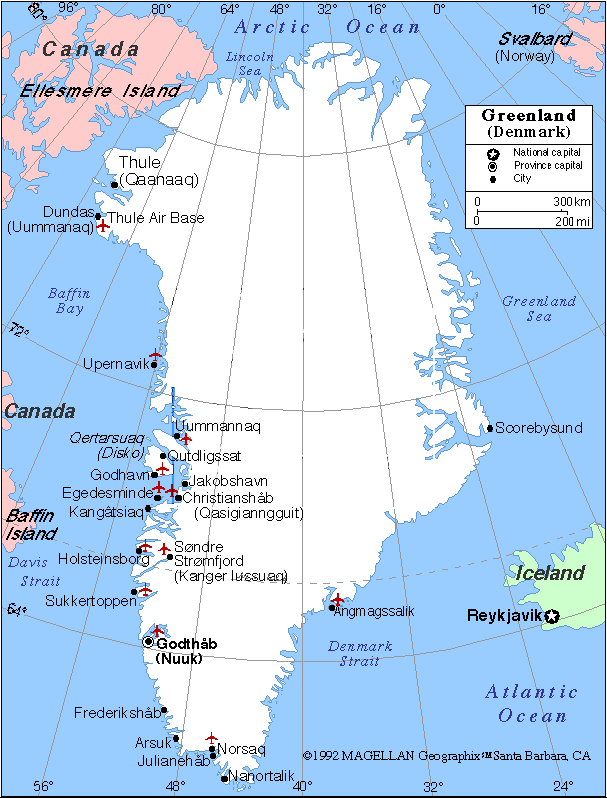
The wind is picking up and the tide is turning. The receding water is being pulled back into Inglefield Fjord, leaving car-sized icebergs stranded on the beach. Black clouds drape the western sky. Since leaving camp we have paddled 35 km along the most rugged, beautiful coast I have ever seen. Now we are but a short distance from the town of Qaanaaq, and are racing to gain land before the low tide leaves us stranded among the icebergs. Around us, everything is in motion. The fierce westerly is churning the shallow water into breakers. Dark, cold water surges around exposed rocks, which we are dodging with our 17-ft double kayaks. Itinerant ice chunks bob on the agitated surface, gnashing and grinding like ice cubes in a witch’s punch. "Follow us!" Steve, our trip leader, yells through the commotion. It looks as if an invisible hand is guiding his kayak through the swells. Jake, the other guide, and I paddle furiously to line up with the kayaks in front of us. Within seconds, wind and waves sweep us into Qaanaaq harbor. Jake jumps out of the stern seat and takes the bowline, walking our boat through the shoals. We reach shore just in time. Within minutes, a vast stretch of shore in front of the town is dry. It’s 8 p.m. on September 2, and our kayak exploration in Inglefield Fjord, in Northwestern Greenland, is over. Soon, we sit clean and dry in the cozy dining room at Hotel Qaanaaq and look out over the storm-swept fjord, where majestic icebergs sail by like giant cruise ships and where the mountains on the other side brace their backs against the massive weight of the inland ice. This was the "Thule Explorer", a two-week kayak expedition organized by Whitney & Smith Expeditions. Wildlife biologists and seasoned Arctic explorers, Jane Whitney and Steve Smith are one of a small number of people who run guided kayak expeditions in Greenland’s northwestern corner, a region called Thule or Avanersuaq – "The Place in the Farthest North." Less than 800 miles from the North Pole, Avanersuaq is the northernmost inhabited place on earth, where one of the last remaining traditional Inuit people live, the Inughuit ("Great People"), as they call themselves. Unlike their Canadian neighbors, the Inughuit are still hunting in the traditional way, pursuing marine mammals such as the narwhal in age-old fashion, with kayak, harpoons and inflated seal-skin floats. There are two reasons for this: preservation of tradition, and sustainable wildlife management. All Arctic marine mammals, except the bowhead whale, sink instantly once killed, resulting in high losses and waste of game for rifle hunters. In contrast, a harpooned animal attached to a float can be shot without losing it. Incredibly isolated, the Inughuit were virtually unknown to the outside world until 1818, when Sir John Ross, a British explorer looking for the northwest passage to India, encountered a small group of them on the Cape York Peninsula, on the northeast coast of Baffin Bay. Still very little was known about the Inuhuit when Lieutenant Robert E. Peary made his first visit to Avanersuaq in 1891. For the next 18 years, Peary and his black orderly, Matthew Henson, depended on the Inughuit for their Arctic explorations. After Peary left (following his now disputed conquest of the North Pole in 1909), outside interest in the region waned. Although Greenland had been a Danish colony since 1721, the Danish concentrated their colonizing efforts on the south. Not until Danish explorers Knud Rasmussen and Peter Freuchen established a trading post in Avanersuaq in 1910, did Denmark gain interest, and subsequently, claim the region in 1921. Today, a total of about 850 people live in Avanersuaq. Most of them still maintain their frugal existence as hunters along that region of Baffin Bay known to the early seafarers as the North Water, a year-round ice-free oasis (polynya) in an otherwise frozen polar sea. The upwelling of nutrients in this polynya supports a rich marine life, which sustains the Inughuit. During our trip, we frequently saw signs of Inughuit hunting activities: sleek, handmade kayaks, equipped with harpoon, seal-skin float and spear; hunters standing on promontories, scanning the sea with binoculars; hunters’ cabins located at strategic points along the coast; and in the settlements, people’s yards littered with bones and blubber – evidence of successful hunts. Getting to Qaanaaq (population about 500), the administrative capital of the Avanersuaq region, is an adventure in itself. From Calgary, Alberta, I flew to Yellowknife via Edmonton, then on to Resolute, NWT, the northernmost airport in Canada reachable by scheduled jet service. From there, our group of eight flew three hours by chartered Twin Otter across Canada’s northernmost Arctic islands to Qaanaaq. The town lies at the entrance of majestic Inglefield
Fjord, which penetrates 100 km inland and, at its head, widens into an
almost circular basin where enormous sandstone and granite mountains
plummet into the sea amid huge tidewater glaciers that spill down from
the Greenland Icecap. For the rest of our two-week trip we paddled these
waters, which are unfrozen for only two months of the year. The drone of the Twin Otter dies as we step on to Qaanaaq’s airstrip in the golden evening light. A group of people is here to greet us, among them Hans Jensen, owner of Qaanaaq’s only hotel. Fresh snow covers the ground, dogs howl in the distance, and before stretches the deep blue fjord, fringed by rounded mountains and the gleaming white expanse of the Icecap. I feel as if I am on a different planet. Everybody is wearing parkas, toques, and winter boots. It’s August 24, but the usual summer weather – glassy seas and temperatures up to + 15° C – didn’t happen this time. Avanersuaq is already in the grip of an early winter. The next morning, an Inughuit with his seasoned fishing boat ferries us across the fjord to a small beach where narwhal hunters have erected a tiny wooden shelter. We pitch our tents, assemble the folding Klepper kayaks, and then investigate our surroundings. An upturned dinghy rests beside the shelter, and the ground is littered with bones and dark brown, rotting whale blubber. A short walk from our beach, a small glacier spills down, ending in boulders before reaching the sea. The wind chases little snow flakes and we shiver, despite our one-piece survival suits and felt-lined rubber boots. Tim and Michael talk about paddling in Baja. In the morning the sea is calmer, but the sky is still gray. Hugging the shore, we paddle a few hours, then stop for lunch, and continue until evening. For the next week, we will travel in this mode, depending on weather and tide. But with 24 hours of daylight, time becomes inconsequential. Sometimes, we start paddling in the evening, and sometimes, we eat dinner close to midnight. Our next campsite is above a sandy beach strewn with narwhal skulls. As we pitch tents, the sun pours through the clouds and exposes a patch of blue sky. "It’s clearing!" Tim shouts. For the rest of the trip, his exclamation becomes our daily invocation. But the weather pays no attention to our entreaties. In the morning, wind and snow start hitting the tents. The whole day, the storm rages, sweeping icebergs towards the north shore and covering the land with several inches of snow. Braving the storm, Jake and I walk along the beach, stopping and stumbling when the gusts hit. The spray from the breakers mixes with the snow squalls, and the pounding waves shatter ice blocks at our feet. In an adjacent bay, the wind has upturned a wooden shack mounted on sled runners. Steve’s tent turns into a social hangout. We sit cross-legged, our faces over the steaming mugs and talk about the endeavors of the early explorers. The next day, the wind has abated. Steve suggests to get going and to visit some friends who live in a place marked on our Danish map as Kangerdlugssuaq. Situated above a small beach, this Inughuit homestead offers spectacular views over Inglefield Fjord. Across the fjord loom the forbidding cliffs of the north shore, to our left stretches the gentler southern shoreline with its rounded mountains and creek outwashes, and to our right, another inlet enters into the fjord. Beyond the inlet, the mountains give way to six glaciers tumbling into the sea.
Behind the houses, we stumble onto a graveyard: big rock piles, marked by white crosses. Through the cracks we glimpse bleached bones and greenish skulls. Steve says they are hundreds of years old. The white crosses were added after conversion to Christianity in this century. Throughout our trip we frequently find graves, usually situated on high ground, overlooking the sea. Each time we feel the presence of the people long gone. In this land, where the pure, dry air prevents disintegration, and where names of explorers such as Peary, Greely and Rasmussen surface in our conversation as if they had trodden the ground yesterday, a sense of timelessness pervades. We have seen icebergs before, but this one is different. At the head of the fjord, a short distance from the town of Qeqertat, we encounter a gleaming, cerulean creature with a scaly back and serrated edges, sculpted by long exposure to sun, wind and sea water. Here is lies, resting in the glassy sea, the water gently lapping at its flanks. At the waterline, the ice gleams aquamarine against its white, glistening coat above. Circling it with our kayaks, we marvel at its unearthly beauty. Later, we arrive at Qeqertat. The village sits on an island at the head of the fjord, surrounded by massive tide water glaciers. The locals come down to the shore to welcome us. We tie the kayaks together and scramble up the rocks into town: a cluster of brightly coloured Danish-made wooden houses. There is a boat dock with fishing boats and dinghies, meat drying racks, wooden food cashes and a big garbage dump with piles of blubber and bones as well as disposable diapers and other "civilized" refuse. The ground is grass-covered. The lushness of the place (due to the nutrients from the refuse) is a welcome surprise in the otherwise barren terrain. Steve explains where we are coming from. A man with gray stubble in his beard leads us to the boat racks, where several kayaks are perched. "Kayak", we exclaim, the only Inughuit word we know. Proudly, the hunter demonstrates his kayak and hunting tools, naming each piece of equipment. We try to imitate the names, which results in lots of laughter around. The kayak is a sleek wooden craft, covered with white painted canvas. Harpoon, spear, paddles and seal-skin float are secured on top, as well as the neatly coiled rope that is attached to the harpoon tip. During the hunt, the kayaker has to get as close as possible to the animal to throw the harpoon. After striking, the harpoon tip remains in the animal, trailing the rope and the float, while the hunter retracts the shaft. Once the animal is tired out, it is shot and towed ashore by a motorboat. One of the villagers speaks a little English, and we learn that the summer’s hunt hasn’t been successful so far. He speculates that a pod of orcas had entered the fjord and chased away the narwhal. Although the kayak plays an important role in the life of the Inughuit, there was a time when the use of kayaks and the hunting of sea mammals in open water was unknown to them. Observations by 19th century explorers such as John Ross and Elisha Kane indicate that the "Arctic Highlanders" – as the Inughuit were called then, didn’t have any wood, and therefore couldn’t build kayaks. With 10 months of winter – "the season of fast ice" – and a very short summer – "the season of no ice" – it is conceivable that the kayak was only known in memory. The people subsisted by hunting seals and walruses from the ice edge and by netting birds and possibly trapping foxes. A Canadian Inuit called Qitdlarssuaq and his small group are credited for having reintroduced the kayak and other hunting tools to the people of Avanersuaq in the latter part of the 19th century. The story of Qitdlarssuaq’s adventurous journey across the ice and the sea between Canada and Greenland, parts of which have only recently been uncovered from Eskimo legend and oral tradition, is recorded at least twice in the white man’s historical record (Commander Edward Inglefield, 1853, and Captain F. L. M’Clintock, 1858). This gave rise to some theories, one of them claiming that this injection of new blood and technology saved the small Inughuit community in Greenland from extinction. In 1976, Rolf Gilberg theorized that one third of the total Inughuit population are direct descendants of the Canadian migrants. Wind and clouds again in the morning. To reach the
north shore, we must leave the protection of the land and cross the
fjord, past Josephine Peary Land (an island named after Peary’s wife)
and past the tongues of four glaciers. Around noon, the southwest wind has moderated and we take off. Snow squalls obscure the rugged shore. Fulmars soar above us, and frequently a seal pops up to eye us. This crossing seems to take forever. My shoulders and arms are aching. To keep going, I start singing, "Farewell to Tarwathie", an old whaler’s song, and Stan Rogers’ "Northwest Passage." The closer we get to the high cliffs, the colder the air feels. After a short break in the lee of an iceberg, we carry on and finally land at a tiny pebbled beach, littered with blocks of ice. A small creek, issuing from a gully, drains into the fjord. We pitch the tents at the entrance of the gully – a wise decision because another storm hits. The next morning, light snow is falling on our camp. We hardly recognize our beach – covered with ice pebbles and a jumble of large ice blocks. Suddenly, there is an excited shout "Narwhal!" There they are. Pod after pod streams towards the head of the fjord. We completely forget about the cold for the next half hour as we watch these mysterious animals pass our camp. Through binoculars, I can see the glistening gray and white speckled bodies, slicing the waves like surfacing submarines. Once, I clearly see the twisted ivory tusk projecting from the snout. It seems they are following some inner calling. Maybe they have located Arctic cod, their main food source. I find myself hoping they are not heading into the harpoons of the waiting hunters at Qeqertat. Since the middle ages, the narwhal, with its ivory tusk, has been the source of legends and myths. Living in an inhospitable and inaccessible environment has contributed to the mystery. One of the three species of resident Arctic whales (the others being the bowhead and the beluga), the narwhal is a small toothed whale around 4.5 m long. The male has a single ivory tusk that grows in a spiral fashion to a length of 2 m. In medieval Europe, the tusks were traded as horns of the mythological unicorn and were highly priced as talismans to ward off danger, evil and disease. To the Inughuit, though, the narwhal has always been a food animal that provides them with meat and material to support their existence. The tusk, once used as a trading article and as construction material for spears and sledges, is now mainly to create carvings and souvenirs, or sold as a whole to museums and collectors. A day later, we are camped on a wide outwash, surrounded by hills and a moraine that leads to the fissured tongue of Hubbard Glacier. Lugging our gear up the beach, we discover a narwhal head with black, rotting flesh and a missing tusk. A short distance from the sea we come upon a small hunter’s cabin. The interior is basic: a tiny space for cooking and standing, backed by a raised sleeping platform, wide enough for four people. Soon, the noise of our camp stoves and the smell of cooking transform the place into a cozy home. Later, five of us climb the moraine and follow its ridge towards the glacier. The wind almost knocks us off. In knee-deep snow, Jake and I descend to the glacier and step gingerly onto the ice, wary of crevasses. On the way back to the cabin we find several narwhal skulls (without tusks) and an upturned kayak resting in the snow. Four of us decide to sleep in the hut rather than in our tents. Listening to the wind outside, I feel privileged to have solid walls around me. In the morning, all is calm, with softly falling snow, and limited visibility. At high tide, we launch the kayaks among the ice blocks, when suddenly the wind comes screaming from the west. Within minutes it has mounted to gale force, whipping the sea into frenzy and driving snow across the fjord. There is no way we can paddle now. Hastily, we pull the boats back out of the water and seek refuge in the cabin. Sitting inside, drinking hot chocolate and reading books from Steve’s Arctic library, we listen to the storm and watch the crashing waves through the open door.
For six hours, the storm rages. Then, in the evening, the sun appears. I run outside – and gasp. The change could not have been more startling. Before me stretches a gleaming white, calm landscape. Icebergs of all shapes and sizes dot the deep blue fjord. Trudging through snow drifts, David and I climb a hill to the east of the hut. A cold breeze stings our faces, but the brilliant sunshine makes us forget the winter conditions. Near the ridge, four white crosses overlook the fjord; two of the graves are child size. I wonder what happened to the people. Did they drown, or starve, or freeze? In this land, where the only tree, the Arctic willow, grows to a height of only two inches to keep away from the fierce wind, animals and plants are constantly struggling for survival. Before the Inughuit had access to modern tools and amenities, their life, too, was extremely precarious. A sudden change in climate, human error, or the unexpected disappearance of game, could spell disaster. Now, modern amenities have changed their lives, but these hunters, sitting in their traditional kayaks, still face the same risks as in the old days. Our last day on the water. Although the sky is gray again, a tailwind from the east encourages us to get going. We pass 1000 m high sandstone cliffs with pinnacles and turrets similar to those in Bryce Canyon. For many hours, there is no landing site. Dodging icebergs, we paddle close to shore, then cross the mouth of Bowdoin Fjord. At its head, Robert Peary constructed his "Anniversary Lodge" in 1893, from which he based many of his Arctic explorations. We didn’t know that history of life would merge in a quirky touch when, before we leave Greenland, Robert Peary junior, Qaanaaq’s customs officer, stamps our passports. For hours, we paddle until Steve guides us into a small ice-choked bay, where we land the boats and seek shelter from the wind behind ice blocks, to eat a quick lunch. It’s snowing and I feel like making camp and crawling into my sleeping bag, but Steve suggests we continue paddling to reach Qaanaaq the same day. So far, we’ve covered 20 km, and it’s another 15 km to Qaanaaq. The only thing that keeps me going is singing. We do make it into Qaanaaq that day, racing against the outgoing tide and slipping into the harbor through the breakers. Again, Steve’s decision to cover the entire distance home proves to be lucky intuition because another storm hits the next day, just a few hours before the expected arrival of our Twin Otter from Canada. This time it’s the worst blizzard I have ever experienced. The wind is blowing at 50 knots and the town disappears in a swirling white mass of blowing snow. The dogs are curled up underneath the snow, and when a few of us venture outside the hotel, the wind pushes us down the slippery streets. Hans, our host, says the storm could last several days, and we all worry about our flight connections from Resolute – if we ever get there in time. We did make it home in time. In the morning, Qaanaaq is gleaming white underneath a blue sky. At noon, our Twin Otter arrives and we say good-bye to our hosts and all the people who have come to see us off. Although I am exhilarated about flying again over this remote part of the earth, and about going home to a place with trees, running water, and T-shirt weather, I feel a bit sad about leaving the vastness and timelessness of Avanersuaq. But the large plates of sea ice I spot while flying over Baffin Bay remind me that soon again Inglefield Fjord will be a white and waveless sea.
|
||||
|
|
|
|
||
|
Photos ©: David Dixson, Michael Haeger, Jake Herrero, Hans Jensen. Text: Karin Herrero. All rights reserved. 11/04/00 Canada |
||||
|
||||


 Except
for the tethered dogs, who hail our arrival, nobody is home. Three
dwellings stand on the spongy, grass-covered ground littered with bones.
Wooden drying racks keep the blubber and meat safe from the dogs.
Looking more closely, we realize that three generations of Inughuit
dwellings are located here: the oldest one, a caved in traditional
winter house made from rocks piled around a circular hole in the ground,
then a sod-house from around the turn of the century, with cellophane as
windowpanes, and finally, a modern Danish pre-fab house with a gable
roof.
Except
for the tethered dogs, who hail our arrival, nobody is home. Three
dwellings stand on the spongy, grass-covered ground littered with bones.
Wooden drying racks keep the blubber and meat safe from the dogs.
Looking more closely, we realize that three generations of Inughuit
dwellings are located here: the oldest one, a caved in traditional
winter house made from rocks piled around a circular hole in the ground,
then a sod-house from around the turn of the century, with cellophane as
windowpanes, and finally, a modern Danish pre-fab house with a gable
roof.


